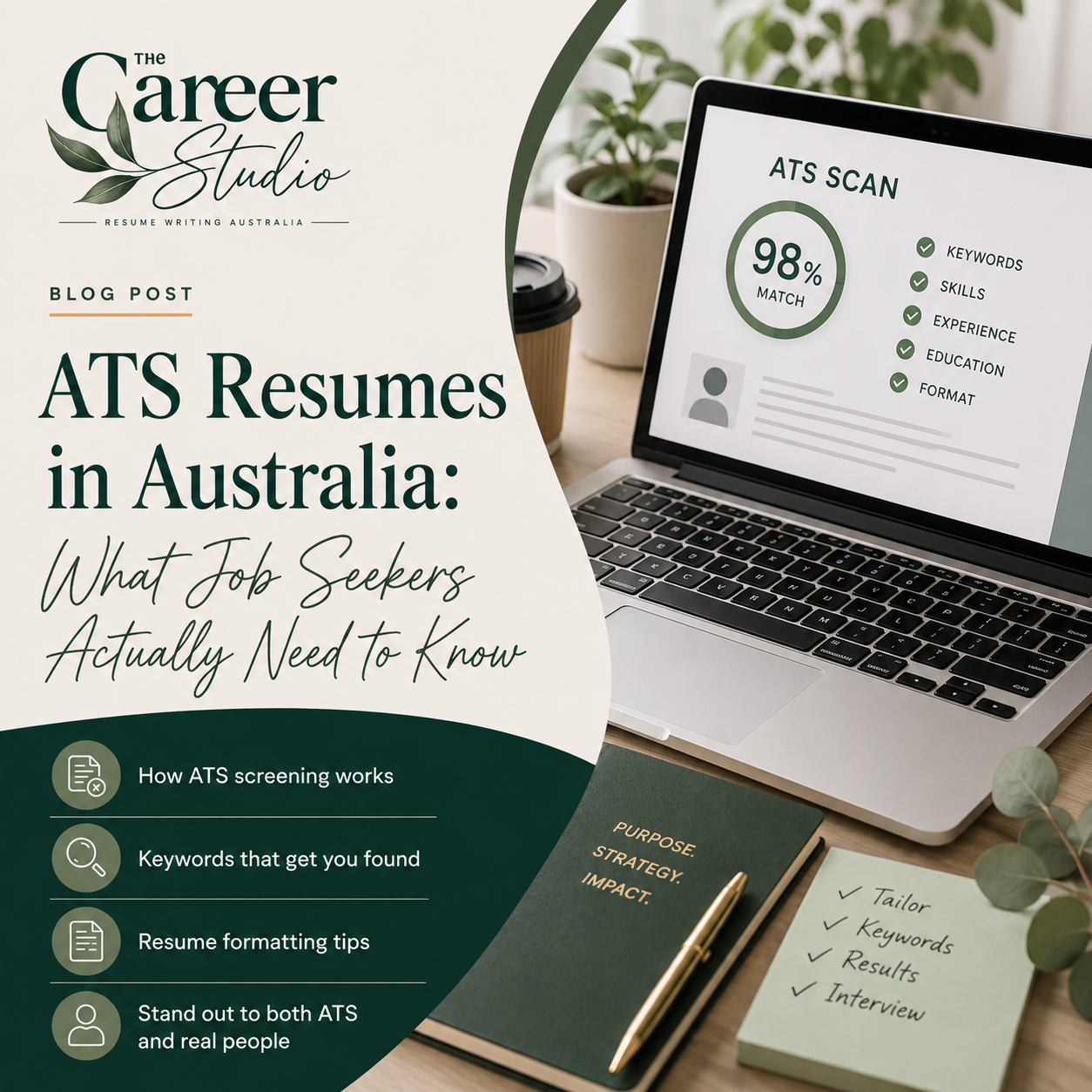
ATS Resumes in Australia: What Job Seekers Actually Need to Know
Applicant Tracking Systems aren't robots deciding your career — but understanding how they work will make your resume stronger.
You may have heard people say:
Your resume needs to beat the ATS.
That makes ATS software sound like some mysterious robot deciding your career.
The reality is less dramatic.
But understanding how Applicant Tracking Systems work can absolutely help you create a stronger resume.
What Is an ATS?
ATS stands for Applicant Tracking System.
Companies use these systems to manage job applications.
Depending on the employer and platform, an ATS may help recruiters:
- organise candidates
- search resumes
- identify keywords
- filter applications
- track candidates through the hiring process
Large companies receiving hundreds or thousands of applications often rely heavily on recruitment software.
Does an ATS Automatically Reject Your Resume?
Sometimes applications can be filtered based on questions, requirements or search criteria.
But job seekers often focus too heavily on trying to "trick" software.
A better strategy is simple: create a resume that both recruitment software and humans can understand easily.
That means clear formatting, relevant language and strong evidence of your skills.
How to Make Your Resume ATS-Friendly
Use standard section headings
Keep headings straightforward. For example:
- Professional Summary
- Employment History
- Education
- Skills
- Certifications
- Licences
Creative headings might look interesting, but clarity matters more.
Use keywords from the job advertisement
If the employer asks for Workplace Health and Safety compliance and you genuinely have WHS experience, include that terminology.
If they require MYOB and you've used MYOB for five years, don't hide it inside a vague statement about accounting software.
Make relevant skills easy to identify.
Avoid keyword stuffing
Repeating the same phrase 25 times isn't going to magically make your resume better.
Your resume still needs to sound natural. Use keywords where they genuinely describe your experience.
Keep your formatting clean
Highly elaborate resume designs may look impressive visually, but they aren't always the best choice for online applications.
Avoid unnecessarily complicated layouts containing excessive graphics or decorative elements.
The purpose of your resume is to communicate information. Design should support that purpose — not compete with it.
Should You Have One Resume for Every Job?
You don't necessarily need to completely rewrite your resume every time you apply.
However, you should tailor important sections. Pay particular attention to:
- professional summary
- core skills
- recent employment
- achievements
- industry terminology
If you're applying for significantly different types of roles, separate resume versions may make sense.
For example, someone applying for both operations management and business development roles may benefit from two versions emphasising different strengths.
ATS-Friendly Doesn't Mean Boring
There is a misconception that ATS resumes must look terrible.
They don't. You can still create a polished, professional document using:
- strong typography
- clear hierarchy
- thoughtful spacing
- subtle design
- consistent formatting
The difference is that readability comes first.
What Matters After the ATS?
This is the part people forget.
Eventually, a human needs to read your resume. And that person wants to know:
- Can this person do the job?
- What have they achieved?
- Why should I interview them?
So don't build a resume exclusively for software. Build one that gets through the system and then convinces the recruiter.
Know your resume has ATS issues but not sure how to fix them?
For $99 I'll personally review your resume and job search approach and give you a clear, prioritised fix list — no rewriting commitment needed.
Keep reading
How to Write a LinkedIn Bio That Gets You Noticed
Your About section is often the first thing a recruiter reads. Here's how to make it specific, searchable and genuinely persuasive.
Why Am I Not Getting Interviews? 7 Resume Problems That Could Be Costing You Jobs
If you're applying for suitable roles and hearing nothing back, your experience probably isn't the problem — how your resume communicates it might be.
How to Write a FIFO Resume That Gets You Noticed
FIFO roles attract huge applicant numbers. Your resume needs to answer one question fast: why you instead of the other 300 applicants?